Flexible, context-sensitive questions to support ethical and inclusive research practice
‘Working’ Prompts for Community-Centred Research
We asked the university's four faculties about their research practices, particularly in relation to working with marginalised and disadvantaged communities. 21 online interviews and 4 focus groups (involving 14 participants) were conducted. Participants’ roles and experience ranged from research associate to professor, and the research contexts discussed extended beyond disciplinary boundaries to include a wide range of community settings. Despite this diversity, a set of common and recurring patterns of learning emerged, which informed the development of a set of working prompts.
These working prompts are flexible and adaptable questions that can be interpreted, modified, and revisited across different research contexts, stages, and relationships. They support researchers to navigate the relational, ethical, and institutional complexities of community-centred research in ways that are responsive to specific research types, community priorities, and changing circumstances, rather than offering fixed guidance or standardised solutions. The working prompts are not intended as universal or prescriptive principles for community-centred research.
These prompts are primarily for researchers and research teams engaged in community-centred or participatory research, particularly with marginalised communities and their cultural context sensitivity. They support researchers in reflecting on their assumptions, positionality, and readiness, and in planning ethically responsible and contextually appropriate engagement. The prompts can also be used collaboratively with communities to co-design research priorities, discuss expectations, and evaluate processes. Additionally, research support staff or public engagement teams may use the prompts to guide training, evaluation, or the planning of community engagement activities.
The positionality of researchers
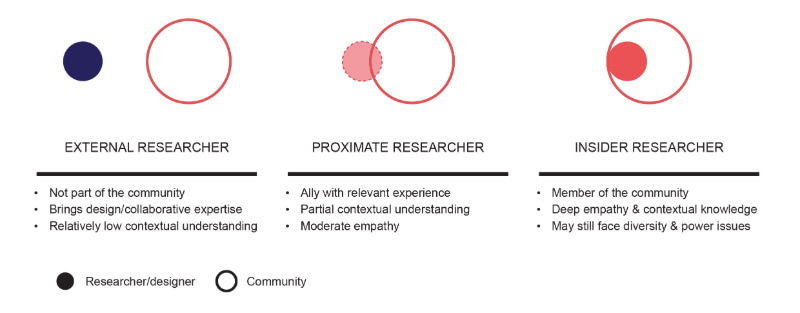
If you are a researcher or part of a team of researchers, you might need to take a moment to reflect on your positionality in relation to the communities you work with. Positionality can shape how trust is built, how knowledge is produced, and how power is experienced and distributed throughout the research process. The data from the RRP project shows that researcher positionality is not fixed but relational and evolving, influencing engagement strategies, expectations, and responsibilities directly and indirectly over time.
The Working Prompts
accordion
These questions are for guiding reflection and discussion across all prompts. By using them as conversation starters, they help ensure that research is inclusive, relevant, and responsive to community priorities.
1. Defining the community
Who do we consider to be part of the community in this research?
Who might be missing, excluded, or underrepresented?
2. Participation and voice
How do people want to be involved in this research?
How does it feel for participants to take part, and what support do they need?
3. Co-creation and agency
Are there ideas, practices, or local knowledge that should shape the research?
How can community members contribute to setting research questions or priorities?
4. Knowledge and perspectives
What experiences, perspectives, or ways of understanding are important for us to include?
Are there forms of knowledge outside academia that we should value and consider?
5. Stakeholders and intermediaries
Who else should be involved, such as community organisations, development agencies, or local leaders?
How can we make sure a wide range of voices are included, not just the loudest or most visible ones?
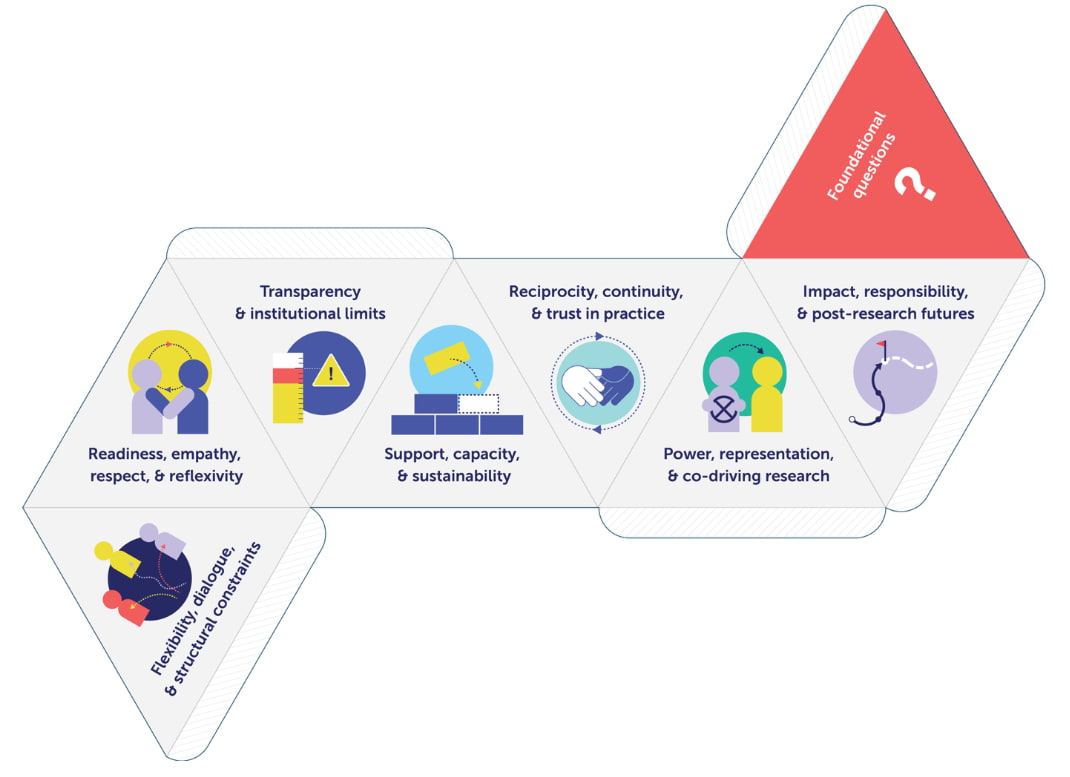
This prompt is for researchers to consider their preparedness and positionality to work respectfully with marginalised communities, rather than assuming empathy or reflexivity as inherent qualities. It acknowledges that various levels of reflexivity and positionality depend on the research type and context. Researchers can build understanding through preparation, clear communication, careful language choices, and, when possible, being present in the community. The prompt also recognises that sustained presence is not always feasible but encourages researchers to reflect on how assumptions, values, and ethical readiness influence engagement.
Core question:
How prepared are researchers to engage ethically, respectfully, and reflexively in this community context?
Sub-questions:
What level of empathy and reflexivity is appropriate for this research type and community?
What assumptions, values, or expectations are researchers bringing, and how can these be made visible and reflected on?
How do practical factors, such as proximity, embeddedness, language choices (including languages other than English), and forms of “leg work”, shape understanding, respect, and engagement, especially when sustained presence is limited?
How prepared are researchers to respect different preferences for involvement, including limited or non-participation?
This prompt highlights the importance of researchers being open about their limitations and the ongoing process of learning in community-centred research. It encourages researchers to make institutional, time, and resource constraints clear and to revisit these issues throughout the research. Instead of seeing transparency as a single step, the prompt suggests making it an ongoing conversation. This approach helps manage expectations, identify capacity needs, and prevent over-promising results.
Core question:
How are project opportunities, limitations, and constraints, communicated and navigated with communities?
Sub-questions / considerations:
What institutional, temporal, or resource limitations exist, and how can they be shared transparently?
How is learning throughout the process acknowledged and practiced?
What capacities, individual, institutional, and community, are needed, and where are the realistic boundaries of what can be offered?
This prompt emphasises that trust and reciprocity need to be clearly defined and put into practice, not taken for granted. It focuses on the real factors that shape relationships, such as how people connect, communicate, and handle transitions or endings. The prompt also recognises the challenge of maintaining ongoing involvement while working within the constraints of short-term research and encourages researchers to think carefully about how to handle continuity, reciprocity, and endings in a responsible way.
Core question:
How are trust and reciprocity actively defined and maintained with communities?
Sub-questions / considerations:
How are benefits discussed, agreed, and revisited with communities over time?
What do communities gain from being involved in this research?
Who decides what counts as a benefit and whose perspectives are prioritised?
How are these benefits reviewed and adjusted over time?
Who are the points of contact, and how do tools, communication, and systems support or inhibit continuity?
How is reciprocity shaped when relationships are time-limited, externally led, or when communities prefer intermittent or indirect involvement?
How are endings acknowledged, communicated, and handled responsibly?
This prompt questions power, inclusion, and knowledge legitimacy within community-centred research. It encourages reflection on who defines the community, whose voices are heard, who is excluded, and who shapes research questions and decisions. Rather than assuming co-design is inherently equitable, the prompt surfaces power dynamics, hierarchies, and potential conflicts, recognising these as integral to ethical and context-sensitive engagement.
Core question:
How are power, decision-making, and knowledge legitimacy negotiated with communities, including decisions about levels of involvement?
Sub-questions / considerations:
Who defines the community in this project, and whose voices are included, over-represented, or missing?
Who generates the research questions, and whose knowledge is considered legitimate and valuable?
How are power, hierarchies, and decision-making authority addressed beyond participation in activities?
How are conflicts within and between communities anticipated and what routes exist to navigate them successfully?
Who has chosen not to be involved, and how are their interests or concerns still acknowledged?
This prompt addresses the need for responsiveness to community priorities while acknowledging the limits imposed by funding, institutional processes, and evaluation requirements. It positions flexibility as something negotiated through dialogue, rather than unlimited adaptation. The prompt encourages researchers to reflect on how structural constraints shape engagement choices and how practical tools or frameworks can support adaptive approaches without placing additional burdens on communities.
Core question:
How are engagement approaches responsive to community priorities within existing structural constraints?
Sub-questions / considerations:
How is dialogue used to identify mutual interests, risks, and possibilities?
What structural or procedural limits (e.g. funding, evaluation) constrain flexibility?
What practical tools or frameworks support adaptation without adding burden to communities and/or researchers?
This prompt asks researchers to critically examine what “support,” “capacity building,” or “empowerment” mean in specific contexts, and for whom. It highlights risks associated with engagement fatigue, short-term projects, and extractive or symbolic forms of capacity building. The prompt encourages attention to sustainability beyond individual projects, including how research may contribute to longer-term systems, relationships, or capabilities valued by communities.
Core question:
How does the project provide meaningful support and contribute to sustainable community capacity?
Sub-questions / considerations:
What does “support” or “capacity building” mean in this specific context, and to whom?
How are engagement fatigue, over-saturation, and the risks of “helicopter research*” being addressed? (*Helicopter research means here a research practice in which rich countries study low-income countries without deep involvement of communities or understanding the context of communities and their culture (Adame, 2021))
How does the project contribute to sustainable systems or capabilities beyond individual participation or short-term outputs?
How does the project avoid assuming that participation or capacity building is always desired or appropriate?
This prompt focuses on responsibility beyond the formal end of a research project. It encourages researchers and communities to reflect on what meaningful impact looks like, who defines success, and how unintended consequences are recognised. The prompt also emphasises the importance of clear boundaries, communicated endings, care for both community members and researchers, and realistic approaches to legacy that avoid creating unsustainable expectations or “fictional” resource spaces.
Core question:
How are impact, responsibility, and post-research outcomes considered and managed ethically?
Sub-questions / considerations:
What kinds of impact or change are meaningful in this context, and who defines what counts as “success” or a “stronger position” of the community?
How are outcomes, unintended consequences, and limitations identified and reflected on collectively?
How are endings, boundaries, recognition (including remuneration), and care, for both communities and researchers, handled responsibly?
What, if anything, is intended to be sustained beyond the project, and how is this discussed and agreed with communities?
Octahedral Die
As a tool for exploring the prompts we use the metaphor of an octahedral die: one face is intentionally left open to invite evolving practices from researchers and communities.
Facilitation Guide
If you are a research or part of a community who wants to make use of the working prompts then we have produced a guide to help you in the process: Working Prompts Facilitation Guide


.jpg)
.jpg)
.jpg)